

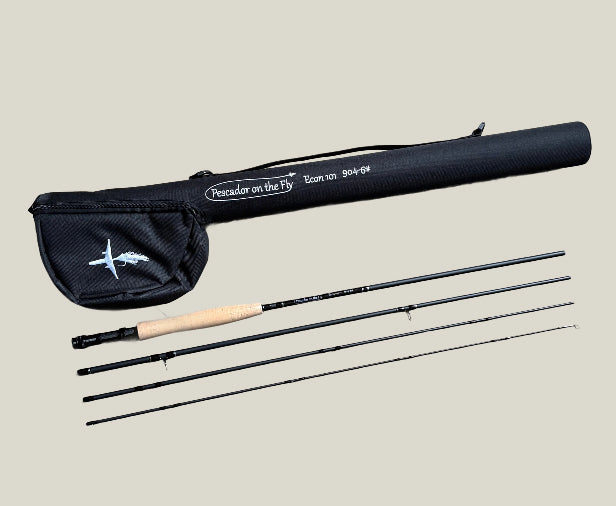


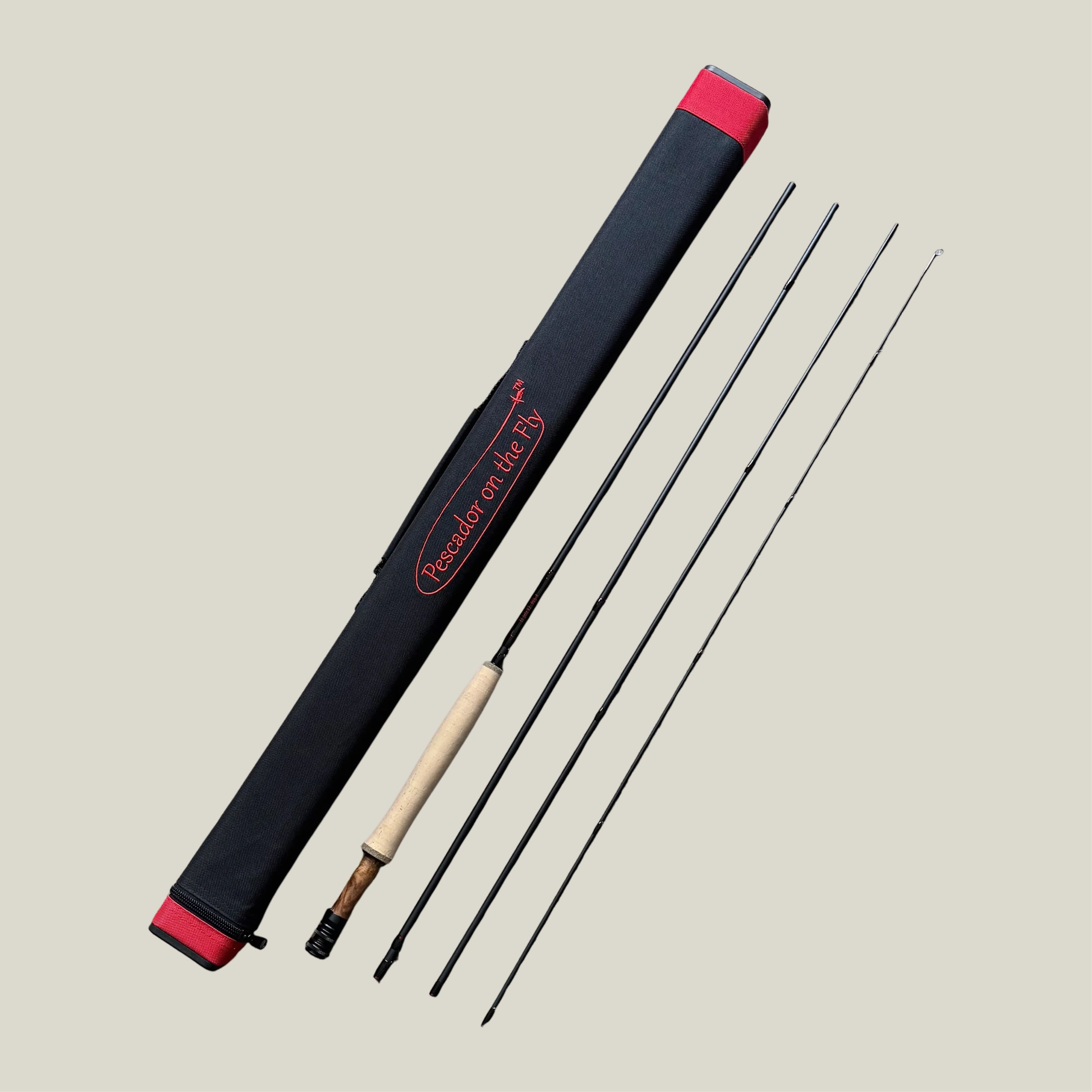
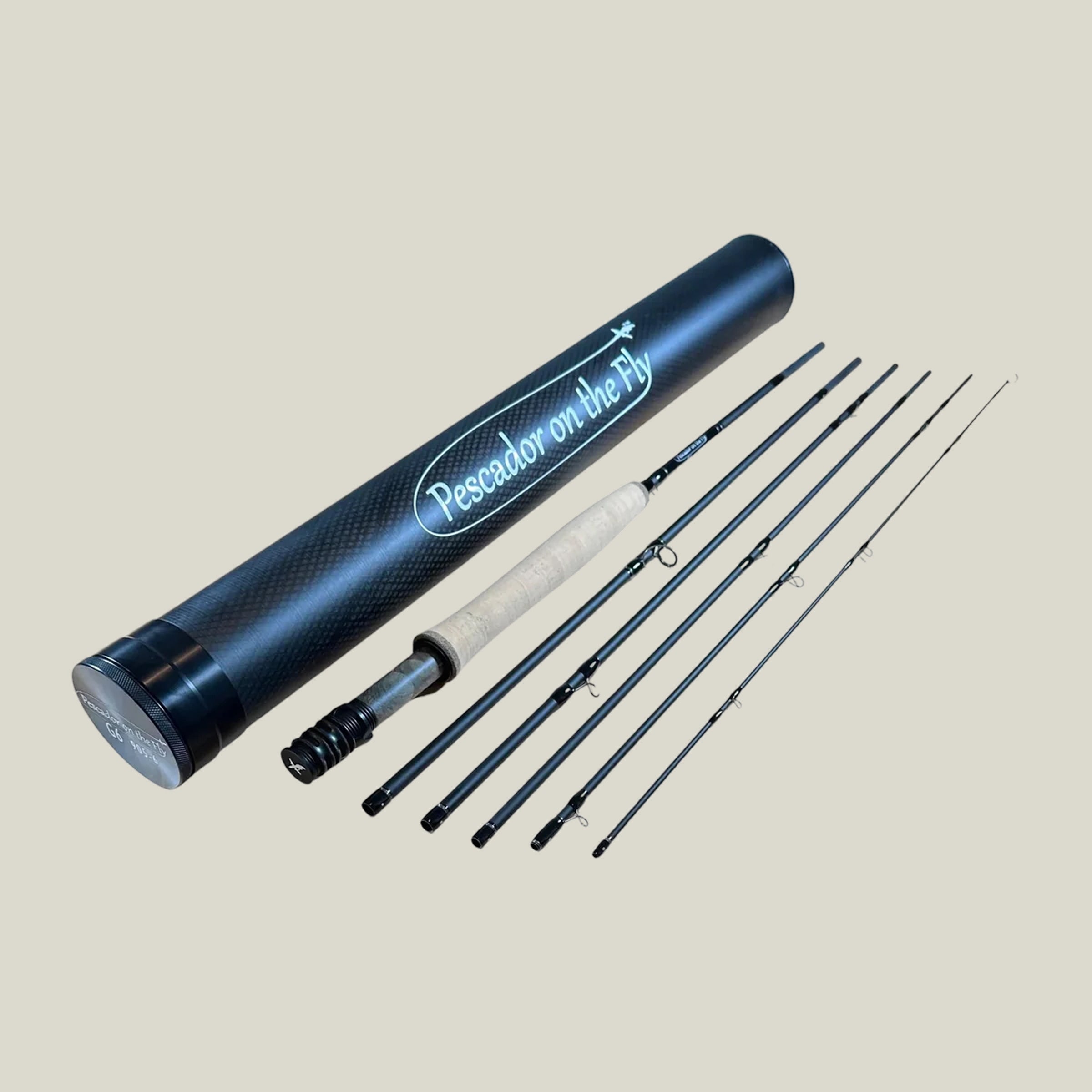
Ask ten anglers for the best travel fly rod and you’ll get ten answers. We build packable, multi-section rods for a living, so we won’t pretend there’s one “best” rod for everyone — but we can tell you exactly what separates a great travel rod from a compromise, and how to pick the right one for the way you fish. If you want the short version: get a six-section rod, in the weight that matches your fishing, in a tube you can carry on — the way our El Rey G6 travel series is built. Here’s the honest, longer version.
Updated August 31, 2026.
What is a 6 piece fly rod?
A 6 piece fly rod is a fly rod built in six sections instead of the standard four, so it packs to roughly 20 inches instead of 30. Nothing else about it is different — same length assembled, same line weight, same job on the water. The only thing you are buying is a shorter tube, and on a travel rod that is the whole point.
People shop for a 6 piece fly rod because they have worked out that a four-piece will not fit in their bag. That instinct is right, but section count is not what you should judge it on. Judge it on packed length, and on whether the ferrules are built well enough that it still casts like a four-piece. Six sections done badly is worse than four. Six sections done right costs you nothing.
6-Piece vs Standard 4-Piece: The Travel Math
| El Rey G6 (6-piece) | Typical premium 4-piece | |
|---|---|---|
| Tube length | 20.25" | ~30" |
| Fits INSIDE a carry-on | Yes | No — the tube rides as its own carry-on item |
| Weights available | 3–9wt | varies |
| Price | $575–$625 | $900–$1,100+ |
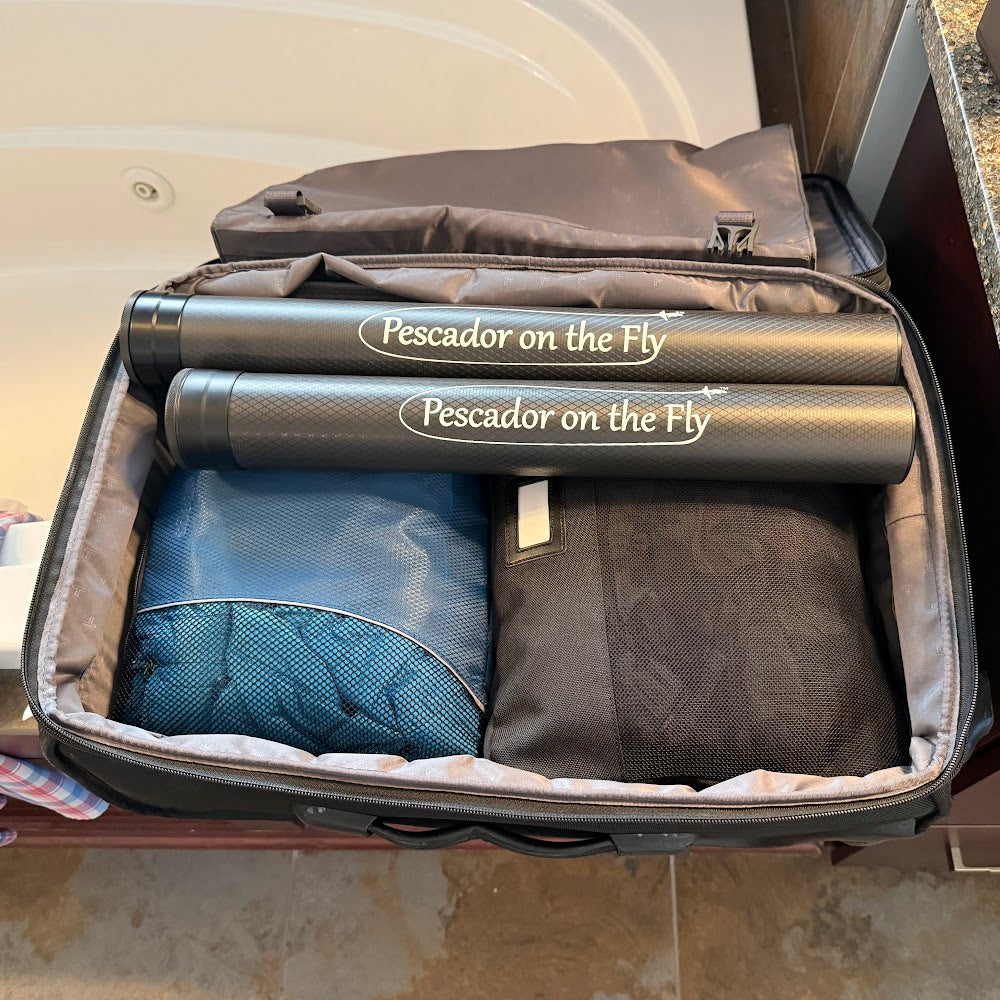
That tube-length difference is the whole game: a 4-piece rod can absolutely fly with you, but its ~30" tube will not fit inside your carry-on — so it eats one of your carry-on item slots and fights you at the overhead bin. The best 6-piece travel rod setup disappears into the bag you were already bringing.
What makes a fly rod a “travel” rod?
A travel fly rod breaks into more pieces than a standard 4-piece rod, so it packs shorter — short enough for a carry-on or a backpack. Most travel rods are 6, 7, or 8 sections. The whole idea is to shrink the packed length without giving up the way the rod casts.
Why a 6-piece travel rod beats a 4-piece for carry-on
The math is simple. A 9-foot rod in four pieces packs to about 30+ inches — long enough that it won’t fit inside a carry-on bag, so the tube rides along as one of your allowed carry-on items and you’re fighting the overhead bin. Plus, once your fly rod tube counts as one of your items, it limits your ability to bring other things. Break that same 9-foot rod into six sections and it drops to roughly 20–21 inches — short enough to slip inside a backpack or a roller bag, so it costs you nothing. That’s the difference between wrestling an oversized tube at the gate and never thinking about it.

Here’s the part that used to be true and isn’t anymore: travel rods used to cast worse. More ferrules — the joints between sections — meant more places for a rod to feel clunky. Modern materials and ferrule design have closed that gap. A well-built six-section rod today casts like a premium four-piece. We’ve fished our El Rey G6 right alongside a four-piece rod and could barely tell the difference in hand. That’s the whole point: with a six-section rod you get carry-on packability and the casting feel of a standard rod, instead of trading one for the other.
Travel fly rod comparison: what to weigh before you buy
When you shop, you’re really comparing three things across three kinds of rod. Here’s how they stack up:
| What to weigh | 6-section travel rod (e.g. El Rey G6) |
Standard 4-piece rod | Ultra-compact 7–8 piece |
|---|---|---|---|
| Packed length | ~20–21″ — carry-on & backpack friendly | ~29–30″ — too long to fit inside a bag; eats an item slot | Under 20″ — smallest packed size |
| Casting feel | Casts like a 4-piece (modern ferrules) | The benchmark feel | Slightly stiffer at the extra joints |
| Travel tube | Round carbon carry-on tube included | Long cloth or PVC tube | Small hard case |
| Line weights | 2–9 weight | Varies by model | Often a narrower range |
| Best for | Anyone who flies, road-trips, or backpacks to fish | Home-water anglers who rarely travel | Deep-backcountry, weight-obsessed packers |
For most people who travel to fish, the six-section rod is the sweet spot — small enough to go anywhere, smooth enough that you forget it’s a travel rod. Temple Fork, Redington, and others build respected multi-piece travel rods too; whatever badge is on it, judge it on those same rows. (We’re direct-to-angler, so our El Rey G6 lands in the $1,000-class of feel without the $1,000 price — but the checklist above is what matters, not the logo.)
How many sections should a travel fly rod have?
- 4-piece: the standard. Packs to ~30″. Fine if you rarely fly with it.
- 6-piece: the sweet spot for travel. Packs to ~20–21″ — carry-on and backpack friendly — with no real loss in feel when it’s built right.
- 7–8 piece: the smallest packed size (under 20″), great for backpacking, with a little more attention needed at the ferrules and, sometimes, a slightly stiffer feel. From our experience, these are not high performance or great feeling.
What length and weight should you choose?
This isn’t really a travel question — it’s the same one you’d ask for any rod:
- 2–3 weight: small creeks, small trout, panfish — delicate presentations.
- 4 weight: a dry-fly rod for smaller water.
- 5 weight: the do-it-all trout rod. If you’re buying one travel rod, start here.
- 7–8 weight: bass, big streamers, and light saltwater like bonefish and redfish (go 7-weight minimum for bonefish, 8-weight all-around).
- 9–10 weight: bigger saltwater and big game.
The beauty of a travel system is that you can carry several weights in one carry-on and cover everything from a mountain creek to the flats. Our rule is never travel with only one rod — and when they’re compact enough, it’s easy. (Not sure which number you need? Our fly rod weight guide breaks down every weight by species and water.)
The 8wt travel rod: one rod for salt, bass, and big streamers
If you only own one travel rod, it should be a 5-weight. If you own two, the second one is an 8-weight — and it is the rod that turns a beach vacation into a fishing trip. An 8wt travel rod handles bonefish and redfish on the flats, smallmouth and largemouth on a lake, and big articulated streamers on a trout river when the water is up and dirty. It is the widest-range rod in the lineup.
The carry-on argument matters more here, not less. Saltwater trips are the ones where you are already fighting baggage — a cooler, a bag of flies, boots that never dry. A ~30″ four-piece tube eats one of your carry-on slots on exactly the trip where you have the least room to spare. Our El Rey G6 8-weight breaks into six sections and packs to about 20″ in its carbon tube, so it rides inside the bag you were already bringing.
- Bonefish: 8wt is the all-around choice; go 7wt only if you fish calm, skinny water and light flies.
- Redfish and light salt: 8wt handles wind and weighted flies without overpowering the fish.
- Bass: 8wt throws poppers and big streamers that a 5wt cannot turn over.
- Big-water trout: 8wt for heavy streamer work in high or off-color water.
Rig it with a saltwater-ready reel and a sealed drag — a fish that runs 100 yards finds every weak point in cheap gear. Not sure whether you want the 7 or the 8? Our fly rod weight guide walks through every weight by species and water.
Can you bring a fly rod on a plane? The 2026 carry-on reality
Yes — you can bring a fly rod on a plane. As of 2026, the TSA lists fishing rods as allowed in both carry-on and checked bags — the final call always rests with the officer at the checkpoint, but a compact rod tube rarely raises an eyebrow. The practical problem was never the rules; it was size. A ~30″ four-piece tube won’t fit inside your carry-on bag, so at best it rides along as one of your allowed carry-on items — eating a slot you’d rather use for something else — and at worst you’re gate-checking it (where rods get lost or crushed). A ~20″ six-section tube fits inside a carry-on or backpack, so it costs you nothing and stays with you the whole trip. That’s the entire case for a travel rod in one sentence: it’s the rod that actually makes it to the water with you. When you go overseas, much of this goes out the window so do some research.
What should you actually look for?
- Modern ferrule technology — that’s what makes a six-section rod cast like a four-piece.
- A real travel tube — a rugged, carry-on-length tube is half the value. It’s what lets you skip the oversized-tube hassle at the gate.
- Action that matches your fishing — medium-fast handles dries, nymphs, and small streamers; faster for wind and big flies.
- Components that last — good guides, a solid reel seat, quality cork. Travel rods get knocked around more than most.
- A warranty you can lean on — things happen on the road; a real repair/replacement path matters more on a travel rod than any other.
Is a travel fly rod worth it?
If you ever fish anywhere but your home water — a work trip, a vacation, a backpacking loop, a buddy’s river — yes. The best rod is the one you have with you, and a travel rod is the one you’ll actually bring. We’ve fished ours on Montana rivers, Caribbean flats, and high-mountain lakes, all out of a single carry-on.

Our take, since we build them
We make the El Rey G6 — our flagship six-section travel rod, built in 2-weight through 9-weight — and every one ships in its own carry-on-ready carbon travel tube. We built it because we were tired of choosing between packability and performance, and because we’re direct-to-angler, you’re not paying a $1,000 price for $1,000 performance. See the full lineup on the El Rey G6 Series page.
But whatever you buy — ours or someone else’s — get a six-section rod, in the weight that matches your fishing, with a tube you can carry on. Do that and you’ll fish more places, more often. That’s the whole point of a travel rod.
Travel fly rods: a few questions we get
Is a “portable fly fishing rod” the same as a travel fly rod? Same thing, different words. Portable, packable, travel — they all point at a rod that breaks into more sections so it packs shorter. The label doesn’t matter; the packed length and whether it still casts right do.
What’s the best fishing rod for travelers? A 5-weight six-section rod in a carry-on tube. If you’re only taking one, take that — it covers trout on just about any water you’ll land near, and it disappears into the bag you were already bringing. Headed somewhere warm and salty? Add an 8-weight. Travel fly rods pack small enough that carrying two costs you nothing.
Tight lines.


Leave a comment
All comments are moderated before being published.
This site is protected by hCaptcha and the hCaptcha Privacy Policy and Terms of Service apply.