



What size fly reel do I need? It's the question that stops most people mid-purchase: you've picked the rod, and now there's a wall of reels with numbers like 5/6 and 7/8 stamped on them, and nobody explains what they mean.
The short answer: match the reel to your rod's line weight. A 5-weight rod takes a 5/6 reel. An 8-weight rod takes a 7/8. That's it — the rest of this page is the detail behind that, plus the handful of cases where you'd size up.
Fly reel size chart by rod weight
| Rod weight | Reel size | What you're fishing |
|---|---|---|
| 2wt | 2/3 | Small creeks, brookies, panfish — delicate presentations |
| 3wt | 2/3 or 3/4 | Small water and spooky trout |
| 4wt | 3/4 | Dry flies on smaller rivers |
| 5wt | 5/6 | The do-it-all trout setup. If you're buying one, this is it |
| 6wt | 5/6 | Wind, bigger flies, streamers, light bass |
| 7wt | 7/8 | Bass, big streamers, light saltwater |
| 8wt | 7/8 | Bonefish, redfish, salmon — the all-around salt weight |
| 9wt | 9/10 | Bigger saltwater, permit, light tarpon |
| 10wt | 9/10 | Big game and heavy wind |
What do the numbers on a fly reel actually mean?
That slash is the whole trick. A 5/6 reel is built to hold a 5-weight or a 6-weight line — one reel, two rod weights. It's why you don't need a reel for every rod you own, and why the chart above has fewer reel sizes than rod weights.
The reason it works: reel sizing is really about spool capacity. The reel has to hold your fly line plus enough backing, without the line packing so tight it comes off in coils. A 5/6 spool has room for either line with the right backing behind it.
Does the reel have to match the rod exactly?
No — and this is where people overthink it. You have a size of leeway in either direction on most trout setups. What you're really protecting is two things: enough room for line and backing, and a rod that doesn't feel tip-heavy in your hand.
Size up one when: you're fishing a heavy sink tip or a shooting head that eats spool room, you want more backing for fish that run, or your rod feels tip-heavy and you want the weight balanced back toward the grip.
Don't size down to save money. A reel that's too small crowds the line, and you'll fight coils every trip.
Sealed drag or click-and-pawl?
Once the size is settled, this is the only other decision that matters much.
A click-and-pawl reel uses a simple gear and pawl for light, non-adjustable resistance. Fewer parts, lighter, easy to maintain yourself, and plenty for small trout where the reel is mostly holding line.
A sealed disc drag uses friction discs in a housing that keeps water, grit and salt out. You get smooth, adjustable, consistent pressure — and it matters the moment a fish takes you into the backing. It also matters in any water carrying sand, and it matters a lot in salt.
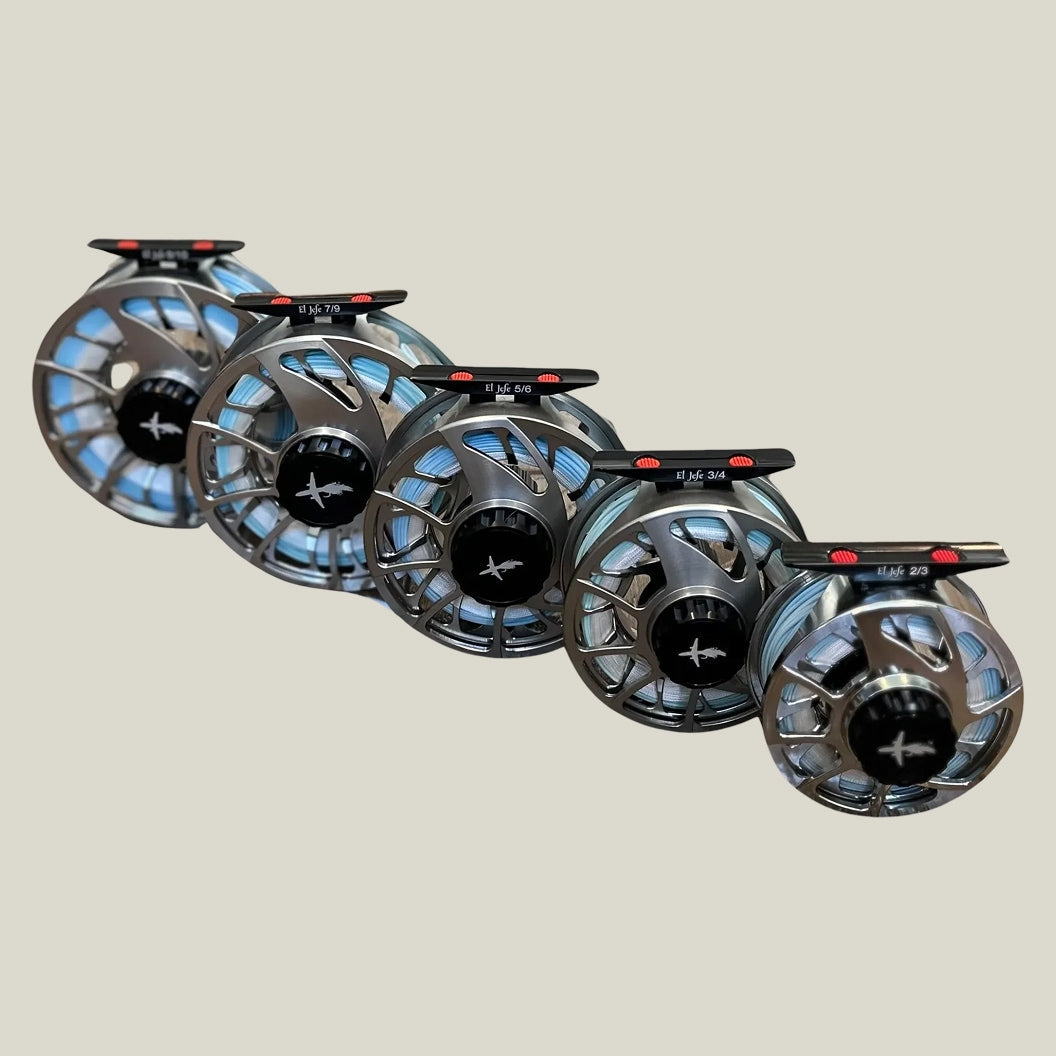
Our El Jefe reels are fully sealed disc drag in aircraft-grade 6061-T6 aluminum, and they run silent rather than clicking. That's a deliberate choice: a sealed housing is what lets a reel survive being dunked, dropped in sand, or fished in salt without a rebuild.
How much should you spend on a fly reel?
Honestly? Less than people think, and more than the bottom of the barrel.
For most trout fishing the reel is doing modest work — holding line, giving you smooth pressure when a good fish runs. You don't need to spend a fortune.
What you do want to watch is what the reel is actually made of. A lot of the least expensive reels out there are largely plastic — plastic frames, plastic spools, plastic drag knobs. They look fine in the box and feel fine on the first trip, then the drag turns rough, a spool cracks when it gets knocked against a rock, and you're buying again next season. It's worth asking the question before you buy, because the answer isn't always on the listing. Both of ours are metal, and both are warranted.
Our Econ 101 reels are $125 and our El Jefe reels are $300–$325, both sold direct so there's no distributor or shop margin in the price. Both are metal, both are warranted. The El Jefe adds the fully sealed drag and the saltwater capability.
One important line: the Econ 101 is a freshwater reel. If you're fishing salt, go El Jefe — sealed drag isn't optional once salt is involved.
Don't forget the line and backing
A reel is only half a system. It needs backing, then the fly line matched to your rod weight. Get that wrong and even a perfectly sized reel fishes badly. Every reel we sell ships pre-spooled with backing and fly line already installed, matched to the weight you order, so there's nothing to figure out and nothing to pay a shop to do.
The short version
- Match the reel size to your rod's line weight — 5wt rod, 5/6 reel.
- The slash means it fits either weight. One reel covers two rods.
- Size up for heavy sink tips, more backing, or better balance. Never size down.
- Sealed drag if there's any chance of sand, salt, or fish that run. Click-and-pawl is fine for small trout.
- Buy the line and backing with it, already spooled, and go fish.
Still not sure which weight rod you need in the first place? Our fly rod weight guide walks through every weight by species and water.
Tight lines.


Leave a comment
All comments are moderated before being published.
This site is protected by hCaptcha and the hCaptcha Privacy Policy and Terms of Service apply.