



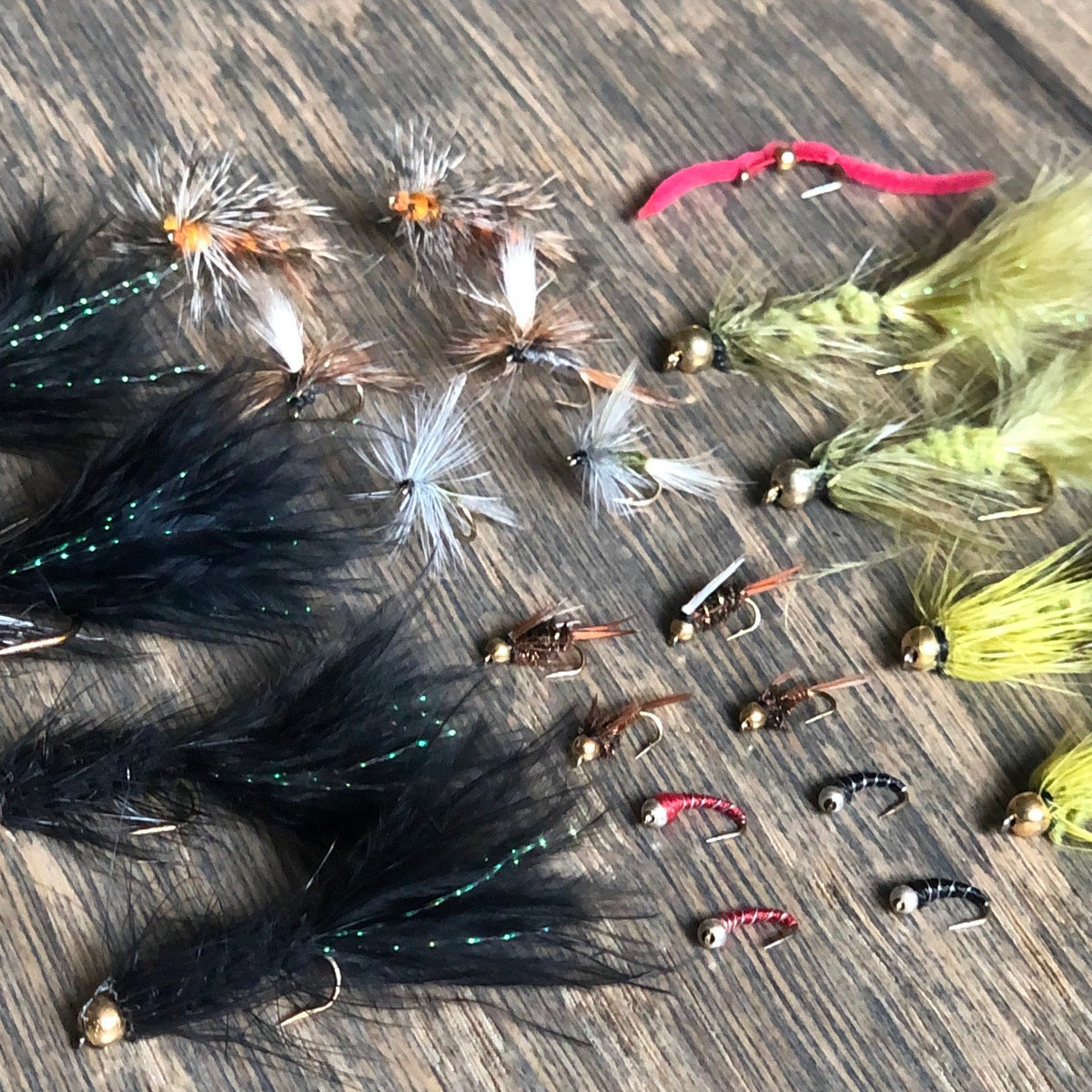
There are thousands of trout patterns out there, and every fly shop has a wall of bins to prove it. Most of those flies will never see water.
Here is the thing nobody says out loud: a small handful of patterns has been catching trout everywhere for decades. Not because they're magic, but because they imitate the things trout actually eat most of the time. Get those right and you can fish almost anywhere in the country.
These are the ten we tie, in the sizes we actually fish. Every one of them is in a box on this site, so you can read the reasoning and then go get the fly.
The best flies for trout, and why each one earns its slot
1. Woolly Bugger

If I could only fish one, this is it. The Woolly Bugger doesn't imitate one thing — depending on how you fish it, a trout can read it as a leech, a baitfish, a big nymph, or a crayfish. Strip it, swing it, or dead-drift it under an indicator. We tie it in olive, black, brown and white, sizes 6 and 10, with bead heads and cone heads to get down fast and plain versions for a slower, more natural swing.
2. Pheasant Tail Nymph

The original was created by the English river keeper Frank Sawyer in the 1950s to imitate a variety of mayfly species. Seventy years later it's still one of the first flies I tie on when I don't know a river. Ours are bead head, sizes 14 and 16. If trout are eating subsurface and you can't tell what, this is the guess that's usually right.
3. Parachute Adams

A modification of the traditional Adams, and the most useful dry fly in a box. The parachute post makes it easy for you to see and easy for the trout to accept, and its grey silhouette passes for a general mayfly across most hatches. Sizes 14 and 16, tied barbless.
4. Elk Hair Caddis

The most famous of the adult caddis patterns. Caddis are everywhere, they hatch through most of the season, and this one floats well enough to fish fast pocket water where a delicate dry drowns on the first drift. Sizes 14 and 16, barbless.
5. Prince Nymph

The attractor nymph. It doesn't match anything precisely — the white biots and peacock herl just read as something alive and worth eating. When the Pheasant Tail gets refused, this is the change-up, and on freestone rivers it often outfishes the more realistic pattern. Bead head, sizes 14 and 16.
6. Hare's Ear Nymph

Same job as the Pheasant Tail with a rougher, buggier profile. The scruffy dubbing gives it movement in the water that a tidy fly doesn't have, which matters most in broken water where a trout gets a short look. Bead head on a jig hook, sizes 14 and 16. If you fish nymphs on a tight line, our complete guide to euro nymphing covers the method in depth.
7. Zebra Midge

Midges hatch every month of the year, which makes this the fly that saves winter days and technical tailwaters. It's about as simple as a fly gets — thread body, wire rib, bead — and trout eat it when they've refused everything bigger. Black and red, sizes 16 and 18.
8. Squirmy Worm

Worms are a constant food source, not a hatch, which is exactly why this works when nothing else does. Trout key on them after rain and in high water because they don't have to work for it. Some people think it's cheating. Those people also get out-fished in off-color water. Bead head, size 12.
9. Green Drake

The exception to the small-and-drab rule. When the drakes come off, trout that have ignored you all week lose their composure for a big mayfly, and it's some of the best dry-fly fishing of the year. It's a short window, and it's worth carrying the fly so you don't miss it. Size 16.
10. Articulated streamers — Sex Dungeon and Circus Peanut

When you're hunting the biggest fish in the river rather than the most fish, you throw meat. Both are jointed, so they kick and breathe on the pause, and the pause is where the eat happens. Fish them tight to banks and structure on a sink-tip, with sharp pulls and pauses. Olive, black and white, sizes 2 and 6. There is more on rigging and retrieves in how to fish big articulated streamers, and on matching a rod to the job in what size fly rod you need for streamer fishing.
How many flies do you actually need?
Fewer than the wall suggests. What matters is that you carry a few sizes of each and that you're willing to change when the drift isn't working. Most days on the water are solved by drift and depth, not by pattern — but you can't fix drift and depth if you don't have the fly.
If you want the wider view beyond trout, we also wrote up the top 10 flies every angler should have in their fly box.
Which box should you buy?
We hand-tie all of these and sell them direct, which is why a box costs what a handful of shop flies costs. Pick by the water you actually fish:
- Essential Trout — 24 flies, $50. The starter box, and the one I'd hand somebody who asked what to buy first. Woolly Buggers, Pheasant Tail, Prince, Parachute Adams, Elk Hair Caddis, Green Drake, Zebra Midges and a Squirmy Worm — two of each.
- Mega Trout — 72 flies, $150. The whole season in one box: everything above plus Hare's Ears and Miracle Midges, three of each, in two sizes. This is the box that goes on the trip.
- Tailwater Technical — 72 flies, $150. For the water that humbles everyone. A deep midge bench, baetis emergers and duns, scuds and sowbugs, all barbless, sizes 12 to 22. If you fish spring creeks or tailwaters, start here instead.
- Trophy Trout Streamers — 36 flies, $150. Sex Dungeons and Circus Peanuts in olive, black and white. Fewer fish, bigger fish.
- Woolly Bugger Pack — 72 flies, $150. One fly, every useful version of it: four colors, three head styles, two sizes.
One last thing
Buy the flies you'll actually fish. A box of forty patterns you don't trust is worse than eight you'll leave on long enough to catch something. Trout don't care what you paid for your rod, and they don't care how many flies are in your box either.


Leave a comment
All comments are moderated before being published.
This site is protected by hCaptcha and the hCaptcha Privacy Policy and Terms of Service apply.